‘Anti-social’ message best for kids’ health amid COVID-19 fears

by Elizabeth Churchman

https://calgaryherald.com/news/local-news/anti-social-message-best-for-kids-health-amid-covid-19-fears/

This article reminds parents, educators and caregivers that we still want our kids to have fun and socialize. Although, because of this outbreak, we have to do things a little differently to still meet those goals of growing their social skills. Pediatricians are saying to never have playdates and to stay as separate as much as possible and to not socialize.

I think this news might bring awareness to families and their children to the fact that the social distancing needs to be monitored in their children because there could be long term effects if not monitored.

Now that educators are more aware of the effects and possible issues that could arise in the classroom once the quarantine is lifted, educators can now respond to different kinds of classroom behaviors from their students. They will know where this behavior may be coming from which can help them get to the source of the problem faster and be able to fix it in a more efficient way.

___________________________________________________________________

Today’s guest blogger is Elizabeth Churchman

Hi! I’m an Early Childhood Education major here at Towson University. I have a passion for teaching the littles and can’t wait to start changing lives

Digital Storytelling

by Amber Sullivan

https://www.educatorstechnology.com/2020/02/digital-storytelling-apps-for.htm

The news article I chose discusses digital storytelling apps and how they can be used to engage your students or how students can use the technology to present information. The article provided several tools teachers can use to promote literacy development, but I chose two apps to evaluate further that were highly rated and free. The first app I took a closer look at is called Shadow Puppet Edu which is an app that allows children to create and personalize their own presentation where they can add personalized pictures or audio to present information. The second app I chose to look at was Little Story Maker which encourages students and teachers to create their own stories using their own family’s photos, voices, and familiar adventures.

I think both apps encourage more family time and interaction. Having parents work with junkchildren on these apps and create stories together creates a time for bonding and storytelling. The stories can either be made up or parents can even engage with their child with a story from their childhood.

The biggest reason I chose these two tools is because they can be used by both student and teacher. Students can use Shadow Puppet Edu to present a project and display their knowledge on a concept. Teachers can use this app to create lessons that are interactive and engaging to the students. The app Little Story Maker allows teachers to present a topic in a fun way by telling a story or children can use it to write a story using their own experience. By allowing students to write a story using their personal pictures or experiences it creates a great opportunity to include culture and celebrate diversity in the classroom.

_______________________________________

Today’s guest blogger is Ms. Sullivan

“My name is Amber Sullivan and I am an Early Childhood Education Major. I am a recent graduate from CCBC, and this is my first semester here at Towson University.”

Best Edtech for Children Backed by Research

by Megan Doonis

https://www.edsurge.com/news/2020-02-06-the-best-edtech-for-students-is-backed-by-research-here-s-what-to-look-for

The article that I read about was geared towards any school in the country and what the perks and downfalls are when it comes to using different apps/programs in the classroom. This being said, the article was written from a nonprofit education department center (Center for children and Technology) and their main focus is how education technology can be used to support learning. The second half of this article focuses on what educators can do to better technology in the classroom and the article provides six different steps on how to succeed at this.This article is very helpful forjunk future educators and extremely informative.

This news will affect young children and their families because technology is such a demand now a days, it is vital for families to understand the importance behind this. For example, there are many resources that teachers can use to communicate with students and their families so having the proper tools in place will allow for success. Technology supports early language by creating new opportunities for interaction and engagement.

This news will influence Early Childhood Education because it will give the teachers the ability to dig deep in research and find out what tech devices will provide a more interactive experience for the class. Not to mention, the students now a days are digital natives which allows them to experiment more in the classroom but it also enhances education and makes it more hands on.

___________________________________________________

Today’s Guest Blogger is Ms. Doonis

“Hi, I am Megan Doonis an energetic and goal-driven student at Towson University majoring in Early Childhood Education. I graduate in Fall 21’ and cannot wait to move away and teach by a beach somewhere!”


Babies and Screen Time

by Sarah Del Rosario

https://blogs.edweek.org/edweek/DigitalEducation/2019/12/babies_twelve_months_screen_time.html

Babies as young as twelve months are exposed to nearly an hour a day of screen time, despite warnings from pediatricians to avoid digital media exposure for children under a year and a half, according to a new analysis released by the National Institutes of Health, the University at Albany, and New York University Lagone Medical Center. It’s not clear what impact this early screen time has on students’ K-12 outcomes. But recently, scores on the National Assessment of Educational Progress declined in both fourth grade and eighth grade reading, leading experts to question whether excessive Candid portrait of asian baby with smartphonescreen time could be having an impact on students’ long-term reading skills. Children whose parents had only a high school diploma were more likely to be exposed to more screen time, as were children of first-time mothers. Twins were also more likely to be in the highest screen time, compared to singleton children. And children in home-based care, whether provided by a baby-sitter, parent, or relative, were more than twice as likely to be in the higher screen time group, compared to kids in center-based care.

According to the article, too much screen time can contribute to developmental delays. Kids aren’t getting the chance to explore their environment. Families will have to spend more time with their kids by limiting their screen time and helping the kids with their homework. This news influences early childhood because if they’re always on the screen, their neurons aren’t being put to use and they can die off. This will also affect teachers helping the children in the classroom because their attention span won’t have the amount of energy to focus on what is being taught in front of them.

____________________________________________

Today’s Guest Blogger is Ms. Del Rosario

“I am a college student currently pursuing a Bachelor’sDegree in Early Childhood Education at Towson University. Always worked with children since high school through a child development course. After high school, I continued my experience through an ESY program in Montgomery County. I went on through college and received my 45-hour certificate for infant and toddler and pursuing to get my 90 hour certificate. Since I have been pursuing volunteering/working with children, I know this is the path I would like to pursue in the present and near future.”

Most children sleep with a mobile phone beside bed

by Brianna Thompson

URL of news article: https://www.bbc.com/news/education-51296197

The article is about the use of cell phones by young children and teenagers. It highlights how children from ages 7-16 spend on average 3 hours and 20 minutes using their phones, whether it be to browse the internet, stream videos, and/or use social media.

This news will affect young children and their families because as time progressesjunk and changes, children are getting their own phones at younger ages and are using the technology with no parental controls or time limits for the use of the phones. Parents will have the choice to either give their children phones at a younger age or to stop the use of cell phones at a younger age, at bedtime specifically, and provide parental controls and restrictions when necessary. As technology advances, it may be harder for parents to find a solution to the use of cell phones in young children and teenagers. Cell phones are the most popular line of communication.
This news will influence Early Childhood Education because educators may want to adjust how often technology is used within the classroom during instruction.The type of technology used within the classroom may need to be changed or evaluated.Educators may also want to take into consideration the type of websites and apps that children and young teens may have access to during the school day and possibly put parental controls or restrictions on certain apps and sites.

____________________________________________________________

Today’s guest blogger is Brianna Thompson

“My name is Brianna Thompson and I’m currently a student at Towson University. My major is Early Childhood Education.”

Using QR Codes to Share Videos with parents

by Madison McCormick

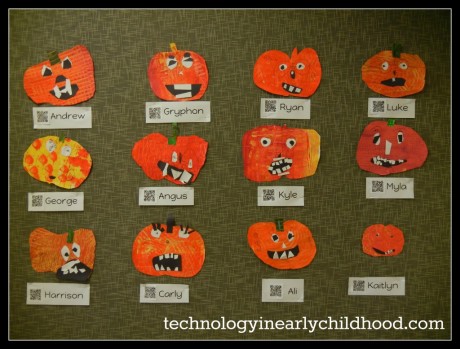
In my article, a kindergarten teacher found a way to use QR codes to share videos of her students and their work with their parents or guardians. She figured out how to make it work using Dropbox.The class went on their annual Fall trip to the pumpkin patch. The teacher wanted the students to have a chance to share about their experience and give them a chance to develop their oral language skills. She asked each child to tell a story about the trip and recorded a video of them on an iPad. Some of the students talked like a robot on video and others went into great detail. The teacher explained that next timejunk she might do a bit more pre-teaching because she thinks some of them just weren’t sure what to say. The children also created Fall pumpkin artwork in their art class. After putting up the student’s pumpkins on the wall, the teacher added each child’s name to their art work followed by the QR code that was linked to each child’s video.
This news will give children a way to learn about a new technique used in technology. The younger students will most likely also find it very interesting and cool.
This creates an easy and fun way for teachers to connect with parents and share the students work in another way other than an ordinary email.
____________________________________________
Today’s guest blogger is Madison McCormick
“I am a junior at Towson University. I live in Brooklyn, New York and I am an Early Childhood Education major.”

Storyboard That: An Exciting EdTech Tool That Just got Even Better

by Seerun Cubuk

https://www.emergingedtech.com/2019/09/storyboard-that-exciting-edtech-tool-just-got-better/

This article talks about an app called Storyboard That which can be used to tell stories, give instructions, or show a process. Students and teachers are able to depict how they want their story to go. This is a great way for students to be creative and interactive with their story. Students are also able to record their own voice into a story.

This news will affect young children and their families by creating positive vibes. Children can use this at home and create stories with their families. Parents can also be able to create a bedtime story and read it to their children.junk

This news will influence Early Childhood Education by giving teachers a new set of ways to give instructions. Using Storyboard That, children may be more attentive and interested into what the teacher is saying. Instead of the teacher giving the instructions to the students,they are explaining it in a way to grab the student’s attention.

___________________________

Today’s guest blogger is Seerun Cubuk

“I’m a Junior at Towson University and I’m majoring in Early Childhood Education. I have a dog named Rocky and he’s 7 years old, and he’s a Maltese Terrier Mix. I like to watch Netflix and my favorite hockey team are the Washington Capitals.”

Are Smartwatches a Smart Choice for School?

by Ashley Son

https://www.thetechedvocate.org/are-smartwatches-a-smart-choice-for-school/

‘Octopus’ creates smartwatches for young children which creates a debate whether it should or shouldn’t be allowed in school. Due to an increase of crimes involving young children, many families feel that it is necessary to track their child at all times. These smartphones also offer up-to-date educational functions and promote healthy habits. Children will learn the concept of time by being alerted when it is bed time and dinner time or even time upcoming events. Smartwatches can also be beneficial for children with ADHD and help improve their daily lives by providing them reminders of certain tasks such as taking medications. This device will sync with parent’s smartphones allowing them to be on the junkloop with their child. Although, smartwatches offer many benefits, it can be very distracting for children. Having a device on you at all times could cause students to not pay attention in school.

How will this news affect young children and their families? This smartwatch can bring peace to families that will know where their child is at all times. For young children, it can improve their daily lives and bring new and different educational opportunities. For early childhood education, it can help students with a very strict medication schedule and keep them on track. With more studies, it might be able to break the barrier between English language speakers and teachers. This can also be very distracting for to the child with the smartwatch and other students; it can also be harder for teachers to control the class.

______________________________________
Today’s guest blogger is Ashley Son, an Early Childhood Education major at Towson University


Chatbots in Education

by Taylor Shehade

https://elearningindustry.com/educational-mobile-apps-chatbots-game-changer

The article starts by briefly explaining what a chatbot is to any unfamiliar readers. It then goes on to explain why it is important for readers to be familiar with the latest technology and how chatbots can be impactful in education. First, it gives a brief overview on how chatbots can be beneficial in education. The article then splits into specific sections of education and lists how chatbots can improve each area. For universities, a chatbot would provide twenty-four-hour support to parents and their students and could be programmed to help them with their admissions or learn more about the college itself. Chatbots can be used to also analyze the students grades and interests and generate classes that fit the students skill level while also being custom tailored to ensure that the students need and or would the class. Which would save students potential hours searching for specific classes and reduces the chances of students taking a wrong class that is not needed for their major. For those who take online classes a chatbot can help instruct the students and answer any questions that they might have with the subject matter when the teacher is not available. For teaching itself, chatbots have a wide range of abilities that can be used to better the classroom. Chatbots are able to answer any questions the students may have in general but can be modified to know the teacher’s lectures, content, and assignments and provide precise assistance with those. Chatbots have also been used to help individuals learn language so it could be a big help for English Language Learners or in language classrooms. Finally, since chatbot technology is still being improved and upgraded, many more opportunities will arise for this technology to serve educators in the future. junk

How will this news affect young children and their families? This technology can help children and their families by offering educational support in any subject the child might take. If the child does not have many resources available to them this one tech could help fill the role of multiple other technologies. Parents who might not be able to help their child out with their schooling, due to lack of time or knowledge, can instead use a chatbot to instruct their child. Parents can also use the chatbot if it is connected to a specific classroom to access lectures and assignments from the teacher to ensure that their child is doing their work. A chatbot would be able to help the parents better assist their child in their education while also keeping them connected. Since it is also just one item,they can avoid buying multiple items to help their child and just use a chatbot to cover various roles.

How will this news influence Early Childhood Education? For Early Childhood Education, this a perfect technological tool as it can be used without any screens which are harmful to young children. A chatbot can be used to help organize the teachers lessons and be used within the classroom to expand it based upon children’s questions and interests. Also, since it has a variety of uses, it is very flexible and can be used for whatever way is needed in the moment. Since the technology is still so new and constantly being updated it does not have a huge impact in the education field in comparison to what it would if it was completely finished.

_____________________________________________
Today’s guest blogger is Taylor Shehade,
a junior at Towson University, majoring in Early Childhood Education and minoring in Deaf Studies

How Robotics in the Classroom can be Beneficial

by Kara Brooks

https://edtechmagazine.com/k12/article/2019/09/how-k-12-classrooms-can-benefit-robotics-perfcon

Our current school population is full of Generation Z students who are considered digital natives. Because of this, there is a need for a new teaching approach which delivers an interactive and immersive experience that is flexible. Some of the new approaches to fulfill those needs are project-based learning (which uses real-world problems to help develop problem-solving skills) and 360-Degree Learning (which uses a combination of play with social development and STEM skills). Using robots and other forms of technology in the classroom can help teachers engage students in the classroom and allow more time for teachers to teach. Some technological tools that teachers can use with their students include: Artificial Intelligence (AI) and Gamification (integrating game mechanics). Robots in the classroom have already been developed. Robin is a 2-foot-tall humanoid robot that helps toddlers learn new languages. Tega is a fuzzy humanoid interactive robot that is prompted by social responses from children. Children tend to treat these humanoid robots as those they are human. There are also robots like Sphero and Ozobot which help children with coding without a computer. Building drones in the classroom is also helping students learn key concepts like aerodynamics, weights, and balance.junk

How will this news affect young children and their families? Young children could be excited by the thought of using technology in school. Some of the robots however could scare the children if they are not implemented correctly. Families could be excited by this or they could be nervous about it. Families could understand that learning about and using technology at a young age can be useful but may still be nervous. Technology may not always be implemented correctly in the classroom leading to the student not learning as much as they from it.

How will this news influence Early Childhood Education? More technology will be implemented into the classroom. This means that more funding could go to providing teachers in all classrooms with technology that could be used to satisfy the educational standards of students. This could also mean that teachers may have more training on how to use technology. Teachers could also receive little to no training on how to use the technology and feel lost when using it or just not use it at all.

___________________________________

Today’s guest blogger is Kara Brooks